
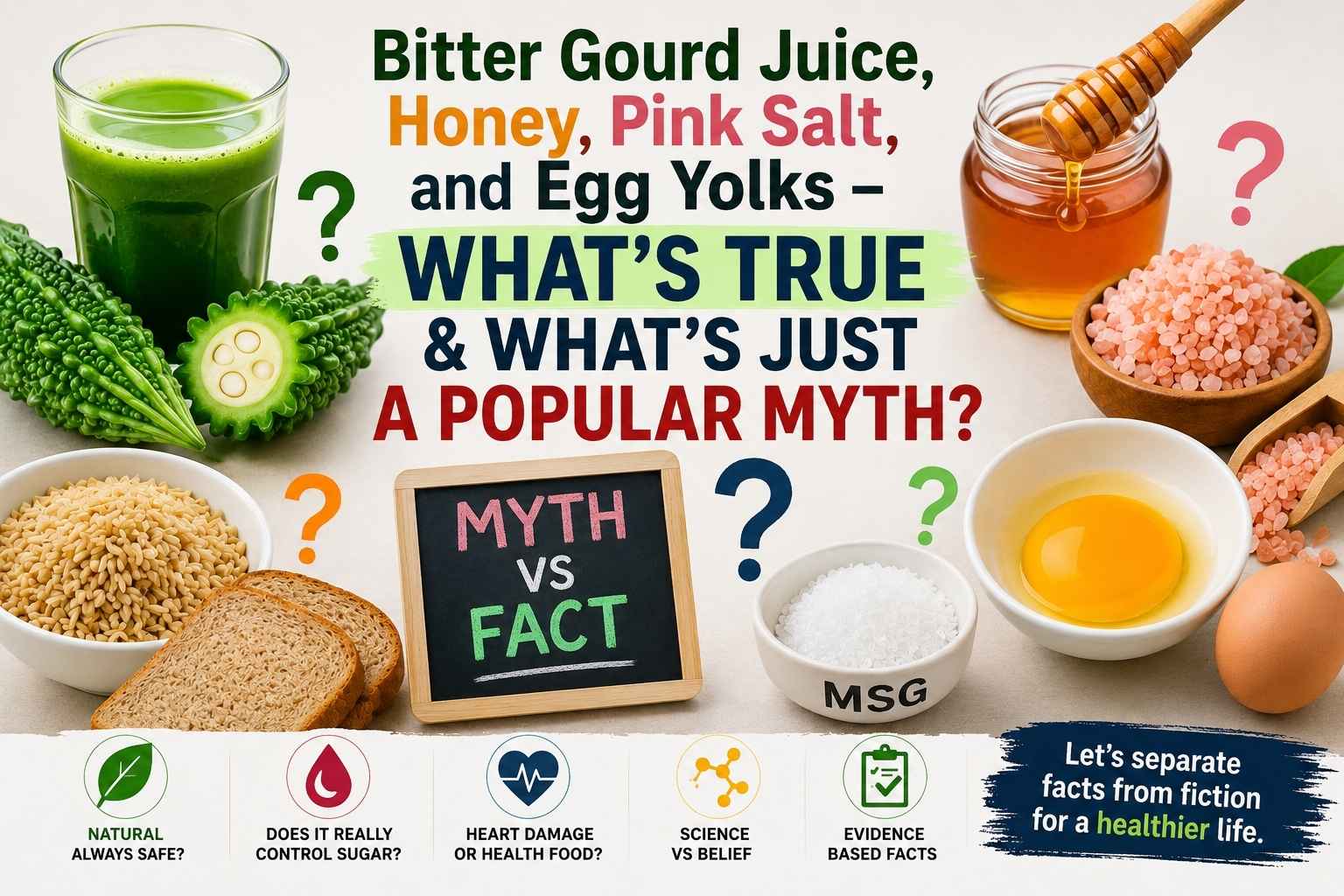
How Many Health Beliefs Do We Accept Without Question?
Most of us grow up hearing health advice from parents, relatives, neighbors, social media, and sometimes even complete strangers.
“Drink bitter gourd juice and your diabetes will be under control.”
“Honey is healthy because it’s natural.”
“Egg yolks increase cholesterol.”
“Pink salt is much healthier than regular salt.”
But have you ever stopped and asked:
How much of this is actually supported by science?
The problem with health myths is that they often contain a small grain of truth. Over time, that tiny truth gets exaggerated until it becomes accepted as fact.
In this article, we’re not taking sides. We’re simply looking at what current scientific evidence tells us.
Let’s separate fact from fiction.
1. Bitter Gourd Juice Can Control Diabetes
This is probably one of the most common diabetes-related beliefs in South Asia.
Many people start their day with a glass of bitter gourd juice hoping it will lower their blood sugar.
So, does it work?
Bitter gourd contains compounds such as:
- Charantin
- Polypeptide-p
- Vicine
Some studies suggest these compounds may help improve glucose metabolism.
The important word here is:
May.
Current scientific evidence does not support bitter gourd juice as a cure for diabetes or a replacement for medication.
Many people make the mistake of reducing or stopping prescribed treatment because they rely too heavily on home remedies.
Reality
Bitter gourd is a healthy vegetable.
It may provide some benefits.
But it is not a cure for diabetes.
Verdict
Myth.
2. Honey Is Diabetic-Friendly Because It’s Natural
This belief sounds logical at first.
After all, honey comes from nature.
But here’s the real question:
Does natural automatically mean safe for diabetics?
Not necessarily.
Honey mainly contains:
- Fructose
- Glucose
Which means honey can still raise blood sugar levels.
Yes, honey contains antioxidants and trace nutrients.
However, that doesn’t change the fact that it is still a source of sugar.
Reality
Honey may offer some nutritional advantages over refined sugar.
But it is not sugar-free.
And it can increase blood glucose levels.
Verdict
Mostly Myth.
3. Brown Sugar Is Better for Diabetics
Brown sugar often enjoys a healthier reputation than white sugar.
Many people assume it’s a healthier choice simply because it looks more natural.
In reality, brown sugar is essentially regular sugar with a small amount of molasses added.
While it may contain tiny amounts of minerals, the difference is nutritionally insignificant.
From a blood sugar perspective, both white sugar and brown sugar behave very similarly.
Reality
Brown sugar is still sugar.
Verdict
Mostly Myth.
4. People with Diabetes Cannot Eat Fruits
This is one of the most widespread misconceptions about diabetes.
Many patients are told:
“Don’t eat mangoes.”
“Don’t eat bananas.”
“Fruit contains sugar.”
While fruits do contain natural sugars, they also provide:
- Fiber
- Vitamins
- Minerals
- Antioxidants
Fiber helps slow down sugar absorption and contributes to overall health.
The real issue isn’t fruit itself.
It’s portion size.
A whole fruit is also very different from fruit juice.
Reality
Most people with diabetes can eat fruits as part of a balanced diet.
Verdict
Myth.
5. Once You Start Diabetes Medication, You’ll Need It Forever
This fear prevents many people from seeking proper treatment.
But the reality is more complicated.
Diabetes is a chronic condition, and many patients may require long-term treatment.
However, that doesn’t mean every patient will stay on the same medication forever.
Weight loss, exercise, and lifestyle improvements can significantly improve blood sugar control.
In some cases, medication doses may be reduced under medical supervision.
Reality
Treatment plans vary from person to person.
Verdict
Partial Myth.
6. Diabetes Is Only a Disease of Older People
Years ago, this belief may have seemed reasonable.
Today, it is no longer true.
Type 2 diabetes is increasingly being diagnosed in:
- Young adults
- Teenagers
- University students
- Even children
Meanwhile, Type 1 diabetes can occur at almost any age.
Reality
Age increases risk, but diabetes is not limited to older adults.
Verdict
Myth.
7. If You Avoid Sugar, You Won’t Get Diabetes
Many people proudly say:
“I don’t eat sugar, so I won’t get diabetes.”
Unfortunately, diabetes is far more complex.
Risk factors include:
- Genetics
- Obesity
- Physical inactivity
- Poor sleep
- Insulin resistance
- Unhealthy eating habits
Excess sugar can contribute to risk, but it is not the only factor.
Reality
Avoiding sugar alone doesn’t guarantee protection.
Verdict
Myth.
8. Natural Foods Are Automatically Safe for Diabetics
This misconception extends far beyond diabetes.
People often assume:
“Natural equals healthy.”
But nature also produces poisonous mushrooms and toxic plants.
Honey is natural.
Dates are natural.
Fruit juice is natural.
Yet all of them can affect blood sugar levels.
Reality
Foods should be evaluated based on nutrition and metabolic impact, not marketing labels.
Verdict
Myth.
9. MSG (Monosodium Glutamate) Is Dangerous
MSG has been controversial for decades.
Many people believe it causes:
- Cancer
- Brain damage
- Serious health problems
However, MSG is simply a flavor enhancer made from sodium and glutamate.
Glutamate naturally exists in foods such as:
- Tomatoes
- Mushrooms
- Cheese
- Meat
Major health organizations including WHO, FDA, and EFSA consider MSG safe when consumed in normal dietary amounts.
Reality
Most concerns surrounding MSG are exaggerated or unsupported by strong evidence.
Verdict
Mostly Myth.
10. Pink Salt Is Much Healthier Than Regular Salt
Pink Himalayan salt has become extremely popular.
Many people believe it:
- Lowers blood pressure
- Protects the heart
- Prevents kidney stones
The truth?
Pink salt is still primarily sodium chloride.
Yes, it contains trace minerals.
But the amounts are usually too small to create significant health benefits.
For Heart Patients
Pink salt still contains sodium.
Excess sodium remains a concern.
For Kidney Stone Patients
There is no strong evidence that pink salt prevents kidney stones.
Reality
Pink salt isn’t harmful.
But it isn’t a miracle health product either.
Verdict
Mostly Myth.
11. Egg Yolks Are Harmful
For decades, egg yolks were blamed for heart disease because of their cholesterol content.
Today, research paints a more nuanced picture.
Egg yolks contain:
- Vitamin A
- Vitamin D
- Vitamin E
- Vitamin K
- Choline
- Iron
- Zinc
In other words, many of the egg’s most valuable nutrients are found in the yolk.
For most healthy people, moderate egg consumption is considered safe.
Reality
Egg yolks are not the nutritional villain they were once believed to be.
Verdict
Myth.
12. All Brown Bread Is Healthy
Many consumers automatically assume brown bread is healthier.
But color can be misleading.
Some brown breads are simply white bread with coloring agents or molasses added.
The real key is checking the ingredients.
Look for:
- Whole wheat
- Whole grain
Not just brown color.
Verdict
Half Truth.
13. Brown Rice Is a Magic Food for Diabetics
Brown rice offers some advantages:
- More fiber
- More nutrients
- Slower digestion
However, it is still a carbohydrate-rich food.
Many people mistakenly believe they can eat unlimited brown rice without consequences.
That’s not true.
Reality
Brown rice may be a better option than white rice for some people, but it is not a miracle solution.
Verdict
Partially True.
Quick Myth Summary
| Claim | Verdict |
|---|---|
| Bitter gourd cures diabetes | Myth |
| Honey is diabetic-safe | Mostly Myth |
| Brown sugar is diabetic-friendly | Mostly Myth |
| Diabetics cannot eat fruits | Myth |
| Diabetes medication is forever | Partial Myth |
| Diabetes only affects older adults | Myth |
| Avoiding sugar prevents diabetes | Myth |
| Natural foods are automatically safe | Myth |
| MSG is dangerous | Mostly Myth |
| Pink salt is significantly healthier | Mostly Myth |
| Egg yolks are harmful | Myth |
| All brown bread is healthy | Half Truth |
| Brown rice is a miracle food | Partial Myth |
Final Thoughts
One of the biggest mistakes we make in nutrition is trying to classify foods as either completely good or completely bad.
Real nutrition doesn’t work that way.
Most foods exist somewhere in the middle.
Their impact depends on:
- Quantity
- Context
- Individual health conditions
- Overall lifestyle
The next time someone says:
“This food cures diabetes.”
Or:
“That food is poison.”
Take a moment and ask:
“What does the evidence actually say?”
Because when it comes to health, evidence is always more reliable than popular opinion.
Leave a Reply