
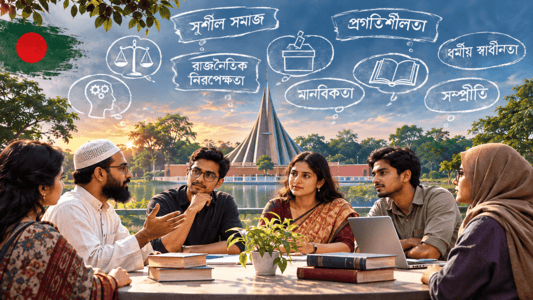
Introduction: Have the Words ‘Civilized’ and ‘Progressive’ Lost Their Meaning?
In Bangladesh, the words civil society and progressive once carried positive meanings. A civilized person was expected to be thoughtful, responsible, respectful and socially conscious. A progressive person was someone who supported education, reason, equality, human dignity and positive social change.
But something interesting has happened in recent years. These words are increasingly used in social conversations with sarcasm, criticism and sometimes even as insults.
Why has this happened? Has progressivism become the identity of a particular political or cultural group? Does someone need to distance themselves from religion to be considered modern? Does expressing Islamic beliefs automatically make a person conservative or less intellectual?
I believe these questions deserve an honest and respectful discussion. Not to attack anyone, but to understand what civil society and progressivism should actually represent.
1. Does Civil Society Belong to a Particular Group?
Being civilized should be about good character, responsibility, fairness, tolerance and respect for other people’s rights.
A person’s political preference, religious identity or lifestyle should not be the only measure of their character.
A practicing Muslim can be civilized. So can a Hindu, Christian, Buddhist or atheist.
The problem begins when a particular group starts considering itself the exclusive representative of education, modernity and progressive thinking.
People with different beliefs are then sometimes labelled conservative, ignorant, communal or backward.
But does disagreeing with someone give us the right to disrespect their intelligence or dignity?
The foundation of a healthy civil society should be the ability to respect people even when we disagree with them.
2. Does Being Progressive Require Distance from Religion?
In some social circles, expressing religious beliefs can create the impression that someone is less modern, less intellectual or less open-minded.
This is a misconception worth questioning.
Progressive values are commonly associated with reason, scientific thinking, education, equality, human dignity and social justice. None of these values automatically requires a person to abandon religious faith.
A Muslim can pray regularly, fast during Ramadan and follow Islamic moral teachings while remaining educated, scientifically curious, compassionate and intellectually independent.
The same principle applies to followers of other religions.
Religious belief and rational thinking do not have to be permanent enemies. People can hold strong personal beliefs while respecting the freedom of others to think differently.
So why should expressing a religious identity become a reason to question someone’s intellectual ability?
3. Political Neutrality: It Must Be Practiced, Not Just Claimed
One important responsibility of civil society is to hold those in power accountable.
It should not matter which political party forms the government. Human rights, freedom of expression, the rule of law and equal citizenship should remain consistent standards.
If the Awami League government committed an injustice, criticism was necessary. If another government commits a similar injustice, criticism is equally necessary.
Remaining silent when a preferred political group is in power while becoming outspoken against political opponents raises legitimate questions about independence.
However, every instance of silence should not automatically be called hypocrisy. Fear, personal safety, limited information and individual circumstances also matter.
The real test of political independence is whether someone can acknowledge wrongdoing by the side they personally support.
4. Does Expressing Religious Beliefs Make Someone Communal?
This distinction is extremely important.
Expressing religious faith and denying the rights of people from other religions are two completely different things.
If a Muslim says that Islam is important to their life and that they want to follow its moral teachings, that statement alone does not make them communal.
Similarly, a Hindu expressing pride in their religious heritage does not automatically indicate hostility toward other communities.
Communal discrimination becomes a concern when people deny others their rights, dignity or security because of religious identity.
If we genuinely want a pluralistic society, religious and non-religious people must enjoy equal freedom to express their views.
5. Does Freedom of Thought Mean Freedom to Insult Religion?
Freedom of thought means having the ability to question, discuss, examine and criticize ideas.
Religious doctrines, institutions and interpretations can certainly be discussed and critically examined through reasoned arguments.
But describing all followers of a religion as ignorant, uncivilized or intellectually inferior is not an example of independent thinking.
Likewise, using religious authority to silence questions and disagreement is also inconsistent with intellectual freedom.
We need a culture where questions are welcome, debates are meaningful and disagreements are normal, but personal humiliation and hostility are not acceptable.
6. Civil Society Needs Self-Reflection
Civil society should be willing to examine its own conduct.
Do we apply the same ethical standards to every political party?
Do we respect the feelings and rights of religious people?
Do we allow people with different opinions to express themselves?
Can we acknowledge our own mistakes?
Do we defend human rights consistently, or only when the affected people belong to our preferred political or cultural group?
These questions are not limited to self-described progressives. They apply equally to religious groups, political organizations and cultural communities.
7. What Kind of Bangladesh Should We Build?
We should aspire to a Bangladesh where Muslims can express their religious identity without embarrassment, Hindus can take pride in their traditions, Christians can practice their faith and atheists can express their personal convictions.
Nobody should be forced to accept another person’s beliefs. Nobody should be forced to abandon their own.
People should be judged by their honesty, compassion, responsibility, reasoning and respect for the rights of others.
Progressivism is not a particular style of clothing, a lifestyle preference or the exclusive identity of a political party.
Conclusion: Character Matters More Than Identity
If we want to restore the dignity of the words ‘civil society’ and ‘progressive’, we must first reflect those values in our own behaviour.
A person who respects freedom of expression, challenges injustice even when it comes from their preferred political side, avoids religious discrimination and engages in reasoned discussion contributes to the values of a healthy civil society.
We need a society where being religious is not considered a weakness, being non-religious is not considered a crime and disagreement does not automatically create hostility.
Civil character is demonstrated through behaviour, not labels. Progressiveness is demonstrated through intellectual freedom and humanity, not through religious identity.
What do you think? Has a section of Bangladesh’s civil society contributed to the loss of public trust through inconsistent behaviour? Or have we simply lost sight of what progressivism and civility really mean?
Share your thoughts in the comments. A respectful disagreement is always welcome.
Leave a Reply